The Online Assessment Toolkit

The Aphasia Online Assessment Toolkit

This FREE toolkit is designed to support clinicians in their use of online assessments with people with aphasia. You can access resources and online training

The Online Assessment Toolkit is a free, web-based resource to support online delivery of aphasia assessments, and provide training for clinicians. It was developed using principles of behaviour change theory as part of the FATE-A study.

The toolkit includes resources for both clinicians and for people with aphasia.

You can find out more and access the toolkit here


The Scenario Test

Scenario test image

https://www.jr-press.co.uk/the-scenario-test.html

The Scenario Test UK Administration Training Resource

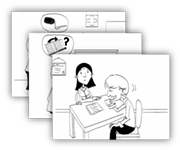
The Scenario Test (validated in the UK) is a daily life communication measure for people with aphasia. It measures how a person with aphasia conveys everyday messages, verbally and/or nonverbally, in an interactive setting. A main strength of The Scenario Test is that it captures all types of communication and how effective they are and it is thus suitable for people with severe aphasia, with no or very limited verbal language.

  • Follow the jr-press URL above to purchase this test from J & R Press.
  • Click the link below to download a PowerPoint presentation providing training on The Scenario Test and its administration.

Download Scenario Test UK Administration Training
Once downloaded, click on the read only button to view the training presentation.
[Please note. This presentation is best viewed on a computer or other large screen.
]


The LUNA resources

This resource contains two documents. The development of this resource was funded by a City, University of London Higher Education Innovation Funding grant, awarded in 2020. The first document is a PowerPoint slide deck which summarises the two LUNA™ journal articles published in 2020. These slides are designed as an alternative to reading the two journal articles and provides pointers for individual clinicians and teams for discussion, reflection, and action. The second document is a toolkit with resources to support discourse assessment & treatment in clinical practice drawn from the journal article findings.


The City Gesture Checklist (CGC)

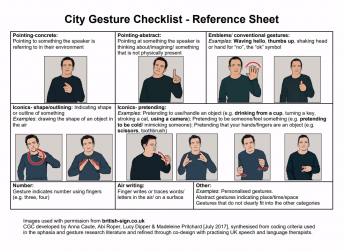
The City Gesture Checklist (CGC) is a ‘quick and dirty’ printable resource for gesture analysis in aphasia. It enables clinicians and researchers to analyse and record the types of gesture produced by people with aphasia without the need for time-consuming video gesture coding facilities. The CGC synthesises coding categories used in the research literature about gesture in aphasia to help clinicians and researchers structure their observations of gesture. Users can record the types of gestures that people with aphasia use and factors affecting gesture use – encouraging reflection on how effectively a person is using gesture.

Download the CGC (English)

Read the supporting research article: Caute, A., Dipper, L., & Roper, A. (2021). The City Gesture Checklist: The development of a novel gesture assessment. International Journal of Language & Communication Disorders, 56(1), 20-35. https://onlinelibrary.wiley.com/doi/full/10.1111/1460-6984.12579 .

The City Gesture Checklist (Caute, Dipper and Roper, 2021) was culturally adapted and translated into Kannada by Chirag Girish Kiran, Analisa Pais and Anna Caute in 2024.

Download the CGC (Kannada)


The EVA Park Therapy Manuals

Research studies have investigated the feasibility of delivering a range of interventions in the virtual environment of EVA Park; functional conversation, noun naming, verb treatment, sentence mapping, storytelling and social support groups.

EVA Park Therapy Manual 1: Noun Therapy
A therapy manual for delivering semantic feature analysis, a noun therapy, in the virtual world EVA Park. The manual was developed in 2016 for use in a research project funded by the Tavistock Trust for Aphasia. With thanks to Mary Boyle and Celia Woolf for permission to adapt the original therapy approaches.

EVA Park Therapy Manual 2: VNeST
Therapy Manual for the verb therapy VNeST delivered in the virtual world EVA Park. This manual was developed in 2016 for use in a research project funded by the Tavistock Trust for Aphasia. With thanks to Lisa Edmonds for permission to adapt the original therapy approach.

EVA Park Therapy Manual 3: Interactive Storytelling
Therapy manual for delivering Interactive Storytelling, a discourse therapy, in the virtual world EVA Park. This manual was developed in 2016 for use in a research project funded by the Tavistock Trust for Aphasia. With thanks to Marcella Carragher for permission to adapt the original therapy approach.

EVA Park Therapy Manual 4: Scripts Therapy
Therapy manual for delivering script therapy in the virtual world, EVA Park. The manual was developed in 2016 for use in a research project funded by the Tavistock Trust for Aphasia. With thanks to Gina Youmans and Katerina Haley for permission to adapt the original therapy approach.

EVA Park Therapy Manual 5: Sentence Mapping Therapy
Therapy manual for delivering mapping therapy, a sentence therapy, in the virtual world, EVA Park. This manual was developed in 2016 for use in a research project funded by the Tavistock Trust for Aphasia. With thanks to Elizabeth Rochon for permission to adapt the original therapy approach.

EVA Park Therapy Manual 6: Functional Conversation
Therapy manual for delivering a functional conversation therapy in the virtual world, EVA Park. This manual was developed in 2013 for use in a research project funded by the Stroke Association: Evaluating Virtual worlds for people with Aphasia (EVA).

EVA Park Therapy Manual 7: Social Support Groups
Therapy manual for delivering a group social support intervention in the virtual world, EVA Park. This manual was developed in 2017 for use in a research project funded by the Stroke Association: Delivering group support for people with aphasia through a virtual communication environment.

Scroll to Top